Blog

  • Top ERP Software Trends in Oman 2026: Cloud ERP, ERPNext, and SME Growth

    Top ERP Software Trends in Oman 2026: Cloud ERP, ERPNext, and SME Growth

    Executive Summary

    Oman’s Vision 2040 digital agenda is accelerating ERP adoption among SMEs in Muscat, Salalah, Sohar and beyond. Cloud-based ERP and open-source platforms like ERPNext offer cost-effective, scalable tools to unify finance, inventory, HR, CRM and more. Key 2026 trends include moving to cloud ERP, leveraging AI and mobile access, and choosing industry-specific solutions. This report compares cloud vs on-premise ERP, ERPNext vs traditional ERPs, and provides implementation tips and ROI guidance for Omani businesses.

    Oman’s Digital Growth and ERP Demand

    Oman’s national strategy (Vision 2040) encourages private sector innovation and digital transformation. Businesses from Muscat to Salalah are adopting modern ERP systems to meet these goals. Local ERP providers (e.g. OmanERP at omanerp.com) emphasize integrated cloud ERP to streamline operations and replace spreadsheets. For example, a unified ERP can handle accounting, sales, inventory, and payroll in one platform.

    Leading companies in manufacturing, logistics and retail are already reaping benefits. In Sohar’s industrial zone, firms use ERP to optimize supply chains, while Salalah trading companies use ERPNext for multi-warehouse operations. These success stories show that ERP software in Oman delivers real-time data, cost savings, and regulatory compliance – vital for Vision 2040 objectives.

    Key ERP Trends in 2026

    1. Cloud Migration Accelerates – Omani companies are rapidly moving to cloud ERP. Cloud solutions lower IT costs, provide automatic updates, and let teams access data anywhere. Industry reports show cloud ERP adoption is growing fast, driven by SMEs needing flexible, scalable systems.
    2. AI and Analytics – ERP systems now use AI for predictive planning and automated reporting. This helps Omani businesses spot trends and manage inventory more accurately. SMEs are integrating AI-driven dashboards to forecast demand and improve decision-making.
    3. Mobile & Remote Access – Modern ERP has mobile apps and browser access, letting managers in Muscat or field staff in Salalah review dashboards on the go. This mobility boosts productivity in retail, healthcare, and services, as real-time ERP data is available outside the office.
    4. Sustainability Metrics – ERP platforms are adding environmental tracking tools. Companies can monitor energy use and waste, aligning with Oman’s sustainability goals. This trend helps industries like manufacturing and logistics manage resources more responsibly.
    5. Industry-Specific Modules – More ERP offerings will be tailored to Omani sectors. For instance, hotels in Muscat may get tourism-specific CRM, and fishermen in Dhofar may use inventory tracking suited for perishable goods. Industry-focused ERP ensures SMEs get relevant features out-of-the-box.
    6. Cybersecurity & Compliance – With digitization, ERP security is paramount. Modern ERP systems include strong access controls, data encryption, and audit trails to meet Oman’s regulatory standards. These features protect sensitive financial and HR data in the cloud.

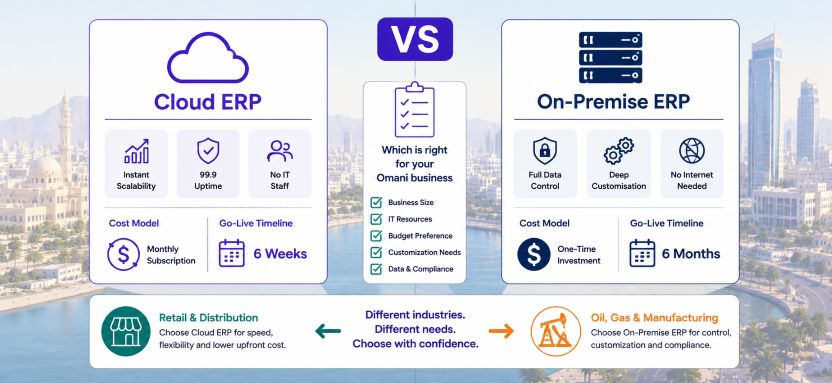
    Below is a comparison of Cloud vs On-Premise ERP solutions relevant for Oman’s market:

    AspectCloud ERPOn-Premises ERP
    Upfront CostLower initial spend (subscription model)Higher (servers, licenses)
    ScalabilityEasily scales up or downScaling requires new hardware/software
    Deployment TimeFaster (weeks)Longer (months)
    MaintenanceHandled by vendor (updates, backup)Handled in-house
    AccessibilityAnywhere access via internetAccess from office network
    SecurityEnterprise-grade cloud securityDepends on internal setup
    CustomizationConfigurable via modulesDeep customization (costly & complex)

    This table highlights why Oman’s SMEs prefer cloud ERP for flexibility and cost savings. Government initiatives (eOman) and SME support policies are further driving this shift.

    ERPNext vs Proprietary ERP (SAP/Odoo)

    In Oman, ERPNext is emerging as a top choice for SMBs. Its open-source model cuts license fees, allowing budgets to focus on training and data migration. ERPNext supports Arabic language and Omani tax rules natively, making deployment smoother. In contrast, proprietary ERPs like SAP or Odoo often involve high costs and complex setups.

    FeatureERPNext (Open-Source)Proprietary ERP (SAP/Odoo)
    License CostFree core (no recurring fees)High yearly fees
    CustomizationFlexible; easily add local featuresCustom work often costly
    Ease of UseIntuitive interface; quick onboardingCan be complex (SAP)
    SupportGlobal community + local partners (OmanERP)Vendor support (may lack local focus)
    Cloud/DeploymentCloud or on-prem optionsOften fixed model; Odoo cloud, SAP on-prem
    Modules IncludedComprehensive (Finance, HR, CRM, Mfg, POS, etc.)Comprehensive but may need add-ons

    Omani companies report measurable gains with ERPNext. For example, a Muscat trading firm cut inventory costs by 20% using ERPNext’s stock analytics, and a Sohar manufacturer improved efficiency by 30% through ERP automation. These success stories underscore ERPNext’s practicality for local businesses.

    Recommendations for Omani SMEs

    • Assess Needs & ROI: List your pain points and quantify benefits. ERP can reduce manual tasks (studies show 30–40% admin savings) and speed up reporting.
    • Choose the Right Partner: Work with local ERP experts who know Oman’s regulations and languages. For example, OmanERP specializes in tailoring ERPNext for Omani firms.
    • Pilot First: Start ERP in one department (e.g., finance or inventory) before rolling out company-wide. This helps fine-tune processes with less risk.
    • Train Users: Invest in employee training. ERPNext’s clean design usually means faster user adoption, but training ensures staff leverage all features.
    • Prefer Cloud ERP: Unless you have strong IT infrastructure, pick a cloud-hosted ERP. It lowers IT overhead and supports remote work.

    ERP Adoption Timeline (2024-2026)

    Practical Features to Look For

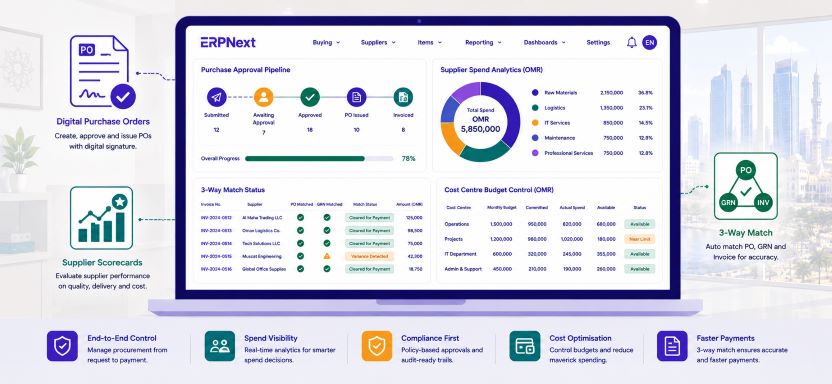
    • Finance & Accounting: VAT/GST compliance, multi-currency, financial reporting.
    • Inventory & Supply Chain: Real-time stock tracking, reorder automation, multiple warehouses (e.g., Salalah, Sohar).
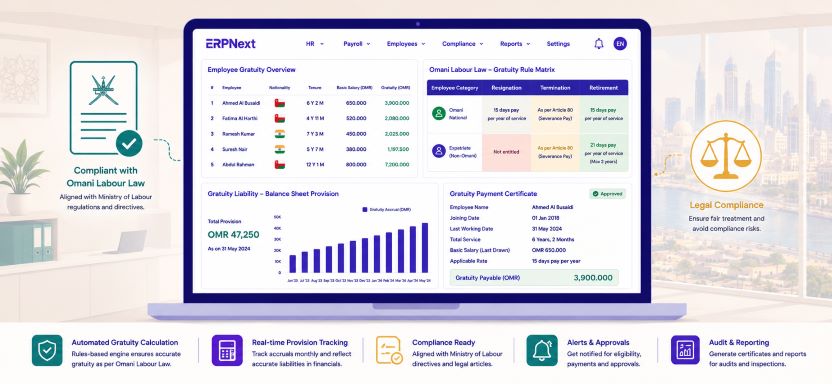
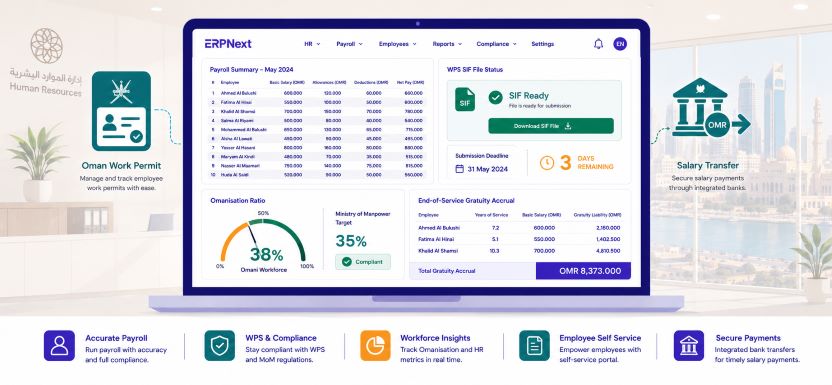
    • HR & Payroll: Oman payroll rules, leave management, labor law compliance.
    • CRM & Sales: Lead tracking, quotations, and post-sales support.
    • Business Intelligence: Dashboards and KPI analytics for real-time insights.

    Modules listed on the OmanERP site (finance, procurement, sales, etc.) exemplify these features. Ensure the ERP covers all critical functions, either natively or via integrations.

    Conclusion

    By 2026, ERP adoption will be widespread among Oman’s SMEs. ERP software in Oman – especially cloud-based ERPNext solutions – offers a path to streamline operations and achieve Vision 2040’s objectives. Embracing these trends with careful planning and local expertise means Omani businesses can compete more effectively and drive sustainable growth. Adopting the right ERP system is an investment in efficiency and growth. Leveraging the latest ERP trends and partnering with knowledgeable providers (such as omanerp.com) will help Oman’s SMEs unlock productivity, improve profitability, and thrive in the digital era.

  • 10 Warning Signs Your Business in Oman Needs an ERP System

    10 Warning Signs Your Business in Oman Needs an ERP System

    Discover 10 warning signs your business in Oman needs ERP software. Learn how ERPNext and cloud ERP in Oman improve efficiency, automation, and growth.

    Introduction

    In today’s competitive market, businesses are under constant pressure to improve efficiency, reduce costs, and scale operations. Many companies still rely on spreadsheets and disconnected tools, which can limit growth and create operational inefficiencies. This is where ERP software in Oman becomes essential.

    An ERP system in Oman integrates all business processes—finance, inventory, HR, and sales—into a single platform. Solutions like ERPNext are helping SMEs modernize operations and gain real-time insights. If your business is facing operational challenges, these warning signs indicate it’s time to adopt an ERP solution.

    1. You Are Using Multiple Systems for Different Processes

    If your accounting, inventory, and HR are managed in separate systems, it leads to data duplication and inefficiency.

    A centralized ERP software in Oman eliminates silos and ensures all departments work with the same data.

    2. Lack of Real-Time Data and Reporting

    Delayed reports and outdated information can affect decision-making.

    A modern cloud ERP in Oman provides real-time dashboards and analytics, enabling faster and smarter business decisions.

    3. Too Much Manual Work

    Manual data entry increases errors and reduces productivity.

    With an ERP system in Oman, repetitive tasks are automated, saving time and improving accuracy.

    4. Inventory Management Problems

    Frequent stock shortages or overstocking indicate poor inventory control.

    An inventory-focused ERP software in Oman helps track stock levels, manage warehouses, and optimize procurement.

    5. Financial Management is Complicated

    If generating financial reports takes too long or contains errors, your system is outdated.

    An accounting ERP in Oman simplifies financial processes and ensures compliance with local regulations.

    6. Poor Customer Management

    Losing track of leads, follow-ups, or customer data affects sales and reputation.

    An ERP with CRM capabilities improves customer relationship management and sales tracking.

    7. Business Growth is Hard to Manage

    As your business grows, managing operations manually becomes overwhelming.

    A scalable ERP system for SMEs in Oman supports expansion without increasing complexity.

    8. Lack of Department Integration

    Disconnected departments lead to communication gaps and inefficiencies.

    An integrated ERP solution in Oman ensures seamless collaboration across teams.

    9. Difficulty in Compliance and Reporting

    Regulatory compliance is critical for businesses in Oman.

    An ERP system in Oman provides structured reporting and helps maintain compliance with financial standards.

    10. Increasing Operational Costs

    Inefficient processes, duplication of work, and errors increase operational costs.

    A cloud ERP software in Oman reduces overhead by streamlining processes and improving resource utilization.

    Why Choose ERPNext in Oman

    Among various ERP solutions, ERPNext in Oman stands out as a cost-effective and powerful platform for SMEs.

    Key Benefits of ERPNext

    • Open-source and affordable
    • Comprehensive modules (HR, Accounting, CRM, Inventory)
    • Customizable to business needs
    • Cloud-based and scalable
    • Easy to use

    ERPNext provides enterprise-level functionality without the high costs of traditional ERP systems.

    Benefits of ERP Software in Oman

    Implementing ERP software offers multiple advantages:

    • Improved efficiency through automation
    • Real-time data for better decision-making
    • Reduced operational costs
    • Enhanced customer experience
    • Scalability for future growth

    With increasing adoption of cloud ERP in Oman, businesses can achieve digital transformation faster and more efficiently.

    Conclusion

    If your business is experiencing any of these warning signs, it is time to consider implementing ERP software in Oman. Relying on outdated systems can limit your growth and competitiveness.

    A modern ERP system in Oman, especially solutions like ERPNext, helps businesses streamline operations, improve productivity, and make data-driven decisions. Investing in the right ERP solution ensures long-term success and sustainable growth.

  • Best ERP Software in Oman for SMEs in 2026

    Best ERP Software in Oman for SMEs in 2026

    In 2026, businesses across Oman are undergoing rapid digital transformation, and Enterprise Resource Planning (ERP) systems have become a critical component for growth. Small and medium-sized enterprises (SMEs), in particular, are increasingly adopting ERP software in Oman to streamline operations, improve productivity, and gain real-time visibility into their business processes.

    With rising competition and the need for operational efficiency, choosing the best ERP software in Oman is no longer optional—it is a strategic necessity.

    What is ERP Software and Why It Matters for SMEs

    ERP software integrates core business functions such as accounting, inventory management, human resources, customer relationship management (CRM), and supply chain operations into a single unified system. Instead of managing multiple disconnected tools, SMEs can centralize their data and workflows.

    For businesses in Oman, this integration offers several advantages:

    • Improved decision-making with real-time data
    • Reduced operational costs through automation
    • Better compliance with financial and tax regulations
    • Enhanced customer experience through streamlined processes

    As SMEs grow, manual systems and spreadsheets become inefficient. ERP systems provide the scalability required to support long-term expansion.

    Key Features to Look for in ERP Software in Oman

    When selecting ERP software, SMEs should evaluate solutions based on their specific operational needs. Some of the essential features include:

    1. Financial Management

    A strong accounting module is essential for managing general ledger, accounts payable/receivable, taxation, and financial reporting. Businesses in Oman require accurate and compliant financial systems to meet regulatory standards.

    2. Inventory and Supply Chain Management

    Efficient inventory tracking, warehouse management, and procurement processes are crucial for trading and manufacturing businesses. ERP systems help reduce stock wastage and improve demand forecasting.

    3. Human Resource Management

    HR modules simplify payroll processing, employee records, attendance tracking, and performance management—saving time and reducing administrative errors.

    4. CRM and Sales Management

    Managing leads, customer interactions, and sales pipelines becomes easier with an integrated CRM system. This helps businesses improve conversion rates and customer retention.

    5. Cloud Accessibility

    Cloud ERP solutions in Oman are becoming the preferred choice due to their flexibility. Businesses can access data anytime, anywhere, without heavy investment in IT infrastructure.

    Why Cloud ERP is Growing in Oman

    Cloud ERP adoption is accelerating among SMEs in Oman due to its cost-effectiveness and scalability. Unlike traditional on-premise systems, cloud ERP eliminates the need for expensive hardware and maintenance.

    Benefits of cloud ERP include:

    • Lower upfront costs
    • Automatic updates and backups
    • Remote access and mobility
    • Faster implementation timelines

    This makes cloud ERP ideal for startups and growing companies looking for agility and efficiency.

    ERPNext: A Leading ERP Solution for SMEs in Oman

    Among the many ERP systems available, ERPNext has emerged as one of the best ERP solutions for SMEs in Oman. It is an open-source ERP platform that offers a comprehensive suite of business applications.

    Why ERPNext Stands Out

    • Cost-effective: No expensive licensing fees
    • Modular design: Includes accounting, HR, CRM, manufacturing, and more
    • Customizable: Easily tailored to specific business requirements
    • User-friendly interface: Simplifies adoption for teams
    • Scalable: Suitable for small businesses as well as growing enterprises

    ERPNext is particularly attractive for SMEs because it provides enterprise-level functionality at a fraction of the cost of traditional ERP systems.

    Industries in Oman Benefiting from ERP Systems

    ERP software is not limited to a single industry. In Oman, several sectors are leveraging ERP solutions to improve efficiency:

    • Retail and Trading: Inventory control, billing, and sales tracking
    • Manufacturing: Production planning, BOM management, and quality control
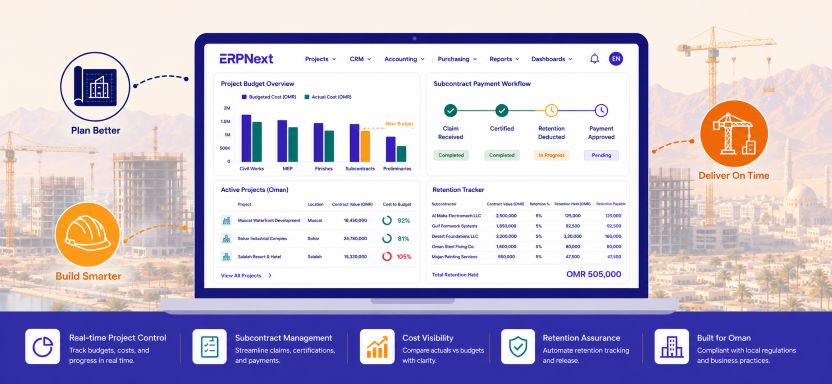
    • Construction: Project management and cost tracking
    • Services: CRM, invoicing, and resource planning

    Each industry benefits from tailored ERP modules that address specific operational challenges.

    Challenges SMEs Face Without ERP

    Many SMEs still rely on manual processes or disconnected systems, which can lead to:

    • Data duplication and errors
    • Lack of real-time insights
    • Inefficient workflows
    • Poor customer service
    • Limited scalability

    Implementing ERP software eliminates these challenges by providing a centralized and automated system.

    How to Choose the Best ERP Software in Oman

    Selecting the right ERP system requires careful evaluation. SMEs should consider the following factors:

    1. Business Requirements

    Understand your operational needs and choose an ERP that aligns with your processes.

    2. Budget and ROI

    Evaluate the total cost of ownership, including implementation and maintenance, and ensure it delivers long-term value.

    3. Customization and Flexibility

    Choose a system that can adapt to your business as it grows.

    4. Local Support in Oman

    Working with a local ERP provider ensures better implementation, training, and ongoing support.

    5. Integration Capabilities

    Ensure the ERP can integrate with other tools such as payment gateways, eCommerce platforms, and third-party applications.

    Future of ERP in Oman

    The future of ERP software in Oman is driven by emerging technologies such as artificial intelligence, automation, and advanced analytics. Businesses are increasingly looking for smart ERP systems that not only manage operations but also provide predictive insights.

    In 2026 and beyond, ERP solutions will play a vital role in helping SMEs:

    • Make data-driven decisions
    • Improve operational efficiency
    • Enhance customer experiences
    • Scale their businesses sustainably

    Conclusion

    ERP software is no longer a luxury but a necessity for SMEs in Oman aiming for growth and competitiveness. With the rise of cloud-based solutions and flexible platforms like ERPNext, businesses now have access to powerful tools that streamline operations and reduce costs.

    Choosing the best ERP software in Oman depends on your business goals, industry requirements, and scalability needs. With the right ERP implementation partner, SMEs can unlock new levels of efficiency, productivity, and profitability.

  • Comparative Review: Leading ERP Systems in Oman for Various Industries

    Comparative Review: Leading ERP Systems in Oman for Various Industries

    In today’s competitive business landscape, choosing the right ERP system in Oman can make or break operational efficiency. From manufacturing to service industries, an ERP (Enterprise Resource Planning) solution centralizes business processes, enhances collaboration, and streamlines decision-making. In this comparative review, we analyze the leading ERP systems in Oman to help businesses select the right software tailored to their industry.

    Why ERP Systems Are Essential for Omani Businesses

    Businesses in Oman, whether SMEs or large enterprises, face growing demands for efficiency, accuracy, and real-time insights. ERP systems Oman offer:

    • Centralized data management
    • Improved process efficiency
    • Real-time reporting and analytics
    • Compliance with local regulations
    • Scalability for future growth

    Investing in the right ERP software Oman ensures businesses stay competitive and aligned with Oman’s Vision 2040.

    Leading ERP Systems in Oman

    1. SAP ERP

    SAP is a global leader in ERP solutions, popular among large enterprises. Its strengths include:

    • Industry-specific modules for manufacturing, retail, and logistics
    • Robust analytics and reporting
    • Strong support and training programs

    Best for: Large-scale manufacturing, oil & gas, and enterprise-level operations

    2. Odoo

    Odoo is an open-source ERP known for flexibility and cost-effectiveness. Key features:

    • Modular design allowing businesses to adopt only required modules
    • Easy integration with e-commerce, CRM, and accounting systems
    • Affordable for SMEs

    Best for: Small to medium-sized enterprises, startups, and service industries

    3. ERPNext

    ERPNext is an open-source, cloud-based ERP gaining traction in Oman. Its advantages include:

    • Low total cost of ownership compared to SAP and Odoo
    • User-friendly interface
    • Supports manufacturing, retail, education, and healthcare industries
    • Easy customization for local business needs

    Best for: SMEs, educational institutions, healthcare providers, and growing businesses seeking an affordable yet powerful ERP solution

    4. Microsoft Dynamics 365

    Microsoft Dynamics 365 offers a comprehensive ERP solution with cloud integration:

    • Seamless integration with Microsoft tools (Office 365, Power BI)
    • Strong reporting and analytics capabilities
    • Scalable cloud-based solution

    Best for: Companies already using Microsoft ecosystems and mid-to-large-sized enterprises

    How to Choose the Right ERP System in Oman

    Selecting an ERP system depends on multiple factors:

    1. Industry Requirements: Manufacturing, healthcare, retail, or service industry needs differ.
    2. Budget: Consider upfront costs, subscription fees, and maintenance.
    3. Scalability: Ensure the ERP can grow with your business.
    4. Ease of Implementation: Cloud-based solutions like ERPNext or Odoo reduce setup complexity.
    5. Support & Training: Reliable vendor support ensures smooth adoption.

    Conclusion

    Oman’s businesses now have multiple ERP software options tailored to different industries. Large enterprises often benefit from SAP or Microsoft Dynamics 365, while SMEs find value in ERPNext and Odoo for their affordability and flexibility. Choosing the right ERP system Oman ensures optimized operations, better data-driven decisions, and long-term growth.

  • A Guide to ERP Solutions for Manufacturing Industries in Oman

    A Guide to ERP Solutions for Manufacturing Industries in Oman

    In today’s competitive manufacturing landscape, efficiency and productivity are crucial for success. For companies in Oman, adopting the right ERP (Enterprise Resource Planning) solutions can transform operations, reduce costs, and improve decision-making. This guide explores how manufacturing industries in Oman can leverage ERP software to achieve operational excellence.

    1. What is ERP for Manufacturing?

    ERP software integrates all business processes into a single system, including:

    • Production planning
    • Inventory management
    • Supply chain coordination
    • Finance and accounting
    • Human resources

    For manufacturing industries in Oman, ERP helps track resources, optimize production schedules, and maintain quality control while ensuring compliance with local regulations.

    2. Benefits of ERP Solutions for Omani Manufacturers

    Implementing an ERP system provides several key advantages:

    a. Streamlined Operations
    ERP centralizes all data, eliminating silos and ensuring smooth workflow across departments.

    b. Real-Time Data and Reporting
    Decision-makers gain access to real-time analytics, enabling faster, informed business decisions.

    c. Cost Reduction
    Automation reduces manual tasks and errors, resulting in operational cost savings.

    d. Enhanced Supply Chain Management
    ERP solutions improve inventory control, procurement, and supplier management for smoother operations.

    e. Compliance and Traceability
    Omani manufacturers can track production processes and maintain regulatory compliance efficiently.


    3. Key Features of ERP for Manufacturing Industries

    A robust ERP system should include:

    • Production Planning & Scheduling – optimize production lines and reduce downtime
    • Inventory Management – track raw materials and finished goods efficiently
    • Quality Management – monitor quality at every stage of production
    • Financial Management – automate accounting and reporting processes
    • HR & Payroll Management – manage workforce efficiently
    • Maintenance Management – schedule preventive maintenance for machinery

    4. Tips for Implementing ERP in Oman

    Implementing ERP successfully requires careful planning:

    1. Assess Your Needs – Identify specific manufacturing processes that need improvement.
    2. Choose the Right ERP Software – Consider cost, scalability, and local support. Popular ERP options in Oman include ERPNext, SAP, and Odoo.
    3. Train Employees – Ensure staff are trained to use the system effectively.
    4. Data Migration & Integration – Migrate data carefully from legacy systems to avoid disruptions.
    5. Start Small & Scale – Implement ERP in phases, starting with critical operations.

    5. Why ERPNext is a Popular Choice in Oman

    For many small and medium manufacturers, ERPNext offers:

    • Affordable pricing compared to SAP and Odoo
    • Open-source flexibility
    • Local support in Oman
    • Modules tailored for manufacturing, inventory, and finance

    This makes ERPNext an ideal solution for companies seeking both efficiency and cost-effectiveness.

    6. Conclusion

    Investing in ERP solutions is no longer optional for manufacturing industries in Oman. With the right system, manufacturers can improve productivity, reduce operational costs, and stay competitive in the evolving market. By understanding your requirements and choosing a system that fits your needs, ERP software becomes a powerful tool for long-term business growth.

  • ERPNext Customization Benefits: Outperforming SAP and Odoo for Oman’s Market

    ERPNext Customization Benefits: Outperforming SAP and Odoo for Oman’s Market

    In Oman’s rapidly transforming business landscape, choosing the right ERP software is no longer just about automation — it’s about adaptability. ERPNext Oman has gained immense popularity among businesses that seek flexible, affordable, and future-ready ERP systems. Unlike SAP and Odoo, ERPNext offers unmatched customization capabilities, allowing Omani enterprises to tailor every module to fit their operational needs, compliance standards, and growth goals.

    This blog explores why ERPNext’s customization flexibility outperforms SAP and Odoo for Oman’s market and how it’s becoming the go-to ERP platform for modern businesses in the Sultanate.

    Understanding ERPNext’s Open-Source Advantage

    One of the biggest differentiators between ERPNext and legacy systems like SAP and Odoo is its open-source foundation. This architecture gives businesses in Oman complete ownership over their ERP system. You’re not bound by vendor restrictions or annual licensing fees — meaning you can customize, scale, and innovate without limitations.

    Unlike Odoo, where additional modules or updates often come at a cost, ERPNext allows organizations to modify workflows, integrate new features, and adjust interfaces freely. This flexibility is particularly valuable for industries like construction, manufacturing, and trading that require dynamic, evolving business processes.

    Localization for the Omani Market

    ERPNext’s adaptability extends beyond technical customization — it also supports localization. Omani businesses benefit from modules configured for VAT compliance, bilingual support (English and Arabic), and region-specific accounting standards. This localized approach ensures ERPNext aligns seamlessly with Oman’s commercial environment.

    GazelleTech Oman, a trusted technology provider, highlights that ERPNext’s customization tools empower businesses to localize operations efficiently while maintaining data accuracy and compliance with Omani regulations. This gives ERPNext a clear edge over SAP and Odoo, which often require expensive localization plugins or external integrations.

    Tailored Workflows That Fit Every Industry

    Every business in Oman operates differently — what works for a construction firm may not suit a retail or logistics company. ERPNext recognizes this diversity by offering modular customization. From HR policies and project management to warehouse operations and invoicing, every process can be adjusted to reflect a company’s internal structure.

    For example:

    • Manufacturers can customize production tracking and quality control modules.
    • Retailers can integrate POS and inventory analytics.
    • Service providers can automate billing, CRM, and employee performance reports.

    In comparison, SAP’s rigid architecture often demands external consultants to achieve similar results — leading to higher costs and longer deployment times.

    Faster Implementation and Lower Costs

    ERPNext’s flexibility doesn’t just simplify customization — it accelerates implementation. Businesses in Oman can deploy a fully functional ERP system in weeks rather than months. Because it’s open-source, ERPNext avoids the licensing and per-user fees that make SAP and Odoo expensive.

    This affordability makes ERPNext especially appealing to SMEs and startups that want to scale efficiently. Many Omani companies report up to 40% savings in total implementation costs when choosing ERPNext over SAP or Odoo.

    The intuitive interface also means teams require minimal training. Employees can quickly adapt to the system, boosting productivity and reducing dependency on external support teams.

    Integration with Existing Systems

    ERPNext integrates easily with other business applications such as eCommerce platforms, cloud storage, and accounting tools. This flexibility allows Omani companies to connect existing software with ERPNext without disrupting current workflows. For example, integrating with payment gateways, HR systems, or data analytics tools can be done seamlessly — saving time and reducing manual effort.

    By contrast, SAP and Odoo users often face compatibility challenges, requiring middleware or costly customization to achieve the same result.

    Empowering Digital Transformation in Oman

    As Oman accelerates toward its Vision 2040 digital goals, companies are prioritizing agility and efficiency. ERPNext plays a crucial role in this transformation journey. Its open architecture encourages innovation by allowing developers and businesses to build new modules or connect advanced technologies like AI and IoT.

    With ERPNext, Omani organizations are not just automating processes — they’re gaining insights, improving collaboration, and driving sustainable growth. This future-ready approach aligns perfectly with the nation’s ambition to create a competitive, knowledge-based economy.

    Why Omani Businesses Prefer ERPNext Over SAP and Odoo

    Let’s summarize the key reasons ERPNext is outperforming SAP and Odoo in Oman:

    1. Open-source freedom — no vendor lock-ins or annual fees.
    2. Faster customization — tailor modules without complex coding.
    3. Localized support — Arabic language, VAT modules, and regional compliance.
    4. Lower cost of ownership — ideal for SMEs and large enterprises alike.
    5. User-friendly interface — minimal training, faster adoption.
    6. Scalable and future-ready — built for Oman Vision 2040.

    Conclusion

    ERPNext’s customization benefits make it the most adaptable ERP solution for Oman’s evolving market. With its open-source flexibility, localized features, and affordability, it gives Omani businesses the tools they need to thrive in a competitive landscape.

    As GazelleTech Oman continues to deliver cutting-edge ERPNext implementation services, more companies across the Sultanate are realizing that customization isn’t just an option — it’s the foundation for long-term digital success.

    ERPNext Oman isn’t just keeping up with global ERP systems like SAP and Odoo — it’s redefining what ERP means for the modern Omani enterprise.

  • ERPNext’s Edge in Oman: Affordable Yet Powerful Compared to SAP and Odoo

    ERPNext’s Edge in Oman: Affordable Yet Powerful Compared to SAP and Odoo

    In a market where ERP giants like SAP and Odoo dominate with high-end solutions, ERPNext brings a refreshing balance of power, simplicity, and affordability—making it a perfect fit for Omani businesses aiming to modernize operations without the heavy investment.

    Revolutionizing ERP for Oman’s Growing Economy

    Oman’s economy is rapidly diversifying, with strong growth in construction, oil & gas, logistics, healthcare, and manufacturing. Businesses in these sectors face the same challenge: integrating processes and data into a single efficient system that supports productivity and transparency.

    While SAP and Odoo offer comprehensive solutions, they often demand complex implementations and premium costs. ERPNext, on the other hand, provides an accessible ERP platform that delivers enterprise-grade performance at a fraction of the price—tailored to Oman’s business environment.

    1. Cost Efficiency Without Compromise

    For most organizations in Oman, ERP implementation costs can be overwhelming. Licensing, consulting, and support fees associated with SAP or even Odoo often exceed budgets for small and mid-sized enterprises.

    ERPNext solves this problem by being open-source and license-free, reducing total ownership costs by up to 60%. The software includes built-in modules for accounting, human resources, CRM, inventory, sales, and project management, eliminating the need for costly third-party add-ons.

    This affordability doesn’t mean compromise—it means greater ROI and faster implementation, allowing even emerging businesses in Oman to enjoy the benefits of advanced ERP systems.

    2. Simplified Customization for Omani Industries

    Every Omani business operates differently. A Muscat-based logistics firm may require fleet management integration, while a construction contractor in Sohar might focus on project cost tracking.

    ERPNext’s modular architecture makes customization effortless. Developers can add new workflows, reports, or dashboards specific to each sector without touching complex core code.

    SAP and Odoo often require expensive customization layers or third-party tools, but ERPNext’s framework lets companies tailor the system in-house, saving both time and money.

    3. Finance Management Made Easy

    Oman’s finance sector values precision, transparency, and compliance. ERPNext’s Finance and Accounting module is designed to handle multi-currency transactions, bank reconciliations, tax management, and detailed financial reporting—all aligned with Oman’s regulatory requirements.

    Where SAP requires heavy configuration and Odoo relies on paid financial apps, ERPNext delivers these capabilities by default. Financial managers in Muscat or Salalah can track profitability, cash flow, and assets in real time, ensuring accurate decisions and regulatory compliance.

    4. Powering Oman’s Manufacturing and Construction Growth

    The manufacturing and construction industries play a vital role in Oman’s Vision 2040. These sectors demand real-time control over production, material costs, and workforce coordination.

    ERPNext enables manufacturers to manage production planning, inventory control, and quality assurance, ensuring that every product meets standards while reducing waste.

    For construction firms, ERPNext integrates project management, procurement, and budgeting tools, allowing site managers and accountants to collaborate seamlessly. Unlike SAP’s complex setup or Odoo’s modular pricing, ERPNext offers an all-in-one approach that scales effortlessly from small contractors to large infrastructure companies.

    5. Cloud-Based Accessibility and Local Adaptation

    Modern Omani businesses thrive on flexibility. ERPNext’s cloud-based deployment means teams can access data anywhere—whether from a head office in Muscat or a remote construction site in Duqm.

    It also supports Arabic interfaces, regional date formats, and tax codes, aligning perfectly with Oman’s business standards. Companies that prioritize data sovereignty can even choose on-premise hosting for complete control.

    This adaptability gives ERPNext a major advantage over SAP and Odoo, which often require regional add-ons or costly localization services.

    6. Strengthening Collaboration and Decision-Making

    ERPNext promotes transparency by connecting departments through a unified data hub. Sales, finance, HR, and production teams can view live dashboards, track performance, and generate automated reports.

    In contrast to SAP’s steep learning curve or Odoo’s fragmented app system, ERPNext’s intuitive interface allows employees at every level to use the system effectively. This fosters collaboration, reduces delays, and speeds up decision-making—a crucial advantage for fast-moving industries in Oman.

    7. ERPNext vs SAP and Odoo: The Omani Perspective

    CriteriaERPNextSAPOdoo
    Initial CostLow / Open SourceVery HighMedium
    CustomizationEasy and FlexibleLimited / CostlyModerate
    Industry FitIdeal for SMEs & Large Local FirmsLarge EnterprisesSMEs
    Localization for OmanExcellentRequires Add-onsPartial
    Ease of UseUser-FriendlyComplexModerate
    DeploymentCloud / On-PremiseOn-Premise / HybridCloud-Based

    Omani businesses that prioritize cost efficiency, flexibility, and local relevance consistently find ERPNext to be the most balanced option.

    8. Supporting Vision 2040 Through Digital Empowerment

    Oman’s Vision 2040 emphasizes economic diversification and technological innovation. ERPNext directly contributes to these goals by empowering local businesses to digitize processes, minimize waste, and increase productivity without relying on expensive foreign software ecosystems.

    From finance and trading to logistics and construction, ERPNext ensures Omani enterprises can scale confidently and compete regionally while keeping operational costs manageable.

    Conclusion

    ERPNext is redefining the ERP landscape in Oman. It’s affordable, adaptable, and powerful enough to compete with global ERP giants like SAP and Odoo—yet simple enough to implement and maintain locally.

    For Omani entrepreneurs, CFOs, and operations managers seeking a cost-effective ERP solution that aligns with Vision 2040, ERPNext is the smart choice for sustainable digital transformation.

  • Unlocking Growth in Oman with ERPNext: A Strong Competitor to SAP and Odoo

    Unlocking Growth in Oman with ERPNext: A Strong Competitor to SAP and Odoo

    As Oman moves closer to achieving the goals of Vision 2040, companies are increasingly adopting ERP systems that are flexible, transparent, and cost-effective. Among the major contenders — SAP, Odoo, and ERPNext — it’s ERPNext that’s gaining attention for its ability to deliver enterprise-level performance at a fraction of the cost.

    This open-source ERP platform provides a simpler yet more powerful approach to managing business processes across industries such as finance, manufacturing, construction, logistics, retail, and trading.

    1. ERPNext and the Financial Transformation in Oman

    In Oman’s growing financial landscape, from small accounting firms to large financial service providers, efficiency and transparency are key. ERPNext’s integrated Finance and Accounting module simplifies daily financial management while ensuring compliance with Omani tax laws and international reporting standards.

    Banks, investment firms, and insurance companies benefit from:

    • Automated financial reporting that enhances accuracy and reduces manual entry.
    • Multi-currency support for seamless global transactions.
    • Built-in cost centers and budget tracking to monitor profitability.
    • Cloud-based access, enabling financial managers to monitor real-time cash flow and account performance from anywhere.

    Unlike SAP, which requires expensive finance-specific licenses, or Odoo, which limits customization without paid modules, ERPNext offers complete flexibility. Financial institutions can tailor dashboards, reports, and workflows to their unique needs — all without ongoing subscription costs.

    As GazelleTech Oman notes, ERPNext gives finance professionals more control over data visibility and analytics, helping them make smarter, faster decisions aligned with Oman’s economic growth targets.

    2. Supporting Manufacturing and Construction Growth

    Beyond finance, ERPNext is playing a major role in Oman’s manufacturing and construction sectors.

    In manufacturing, ERPNext handles production planning, inventory, and material tracking. For companies operating in Sohar and Rusayl Industrial Estates, this means better cost control and efficient resource allocation. Real-time analytics help plant managers anticipate supply chain issues before they impact production.

    For construction companies, ERPNext offers project-based accounting, contractor management, and progress tracking. Firms like NGL Construction could manage budgets, resources, and materials seamlessly through ERPNext’s project management tools.

    While SAP may offer similar capabilities, its high licensing and maintenance costs often put it out of reach for SMEs. ERPNext, being open-source, levels the playing field — enabling smaller Omani construction and manufacturing firms to compete effectively.

    3. ERPNext for Retail, Trading, and Logistics

    Retail and trading firms in Muscat and Salalah are leveraging ERPNext for its integrated Point-of-Sale (POS), stock management, and CRM systems. It gives them a unified view of inventory, customers, and sales trends — helping them stay competitive in an increasingly digital marketplace.

    Logistics companies are also seeing major benefits. ERPNext’s shipment tracking, warehouse control, and fleet maintenance tools simplify operations while cutting costs. In contrast, SAP and Odoo require multiple add-ons for similar functionality.

    With implementation partners such as OmanERP, local businesses enjoy personalized ERPNext deployments tailored to their operational workflows and regulatory needs.

    4. Why ERPNext Stands Out for Oman’s Businesses

    a. Affordability Without Compromise

    ERPNext eliminates the burden of recurring license fees and per-user costs. This cost advantage makes it ideal for Omani SMEs seeking full ERP functionality without financial strain.

    b. Ease of Customization

    ERPNext’s modular design allows developers to create custom apps for Omani business environments — from tax modules to Arabic-language dashboards — ensuring local relevance that SAP and Odoo can’t easily match.

    c. Intuitive User Experience

    Its clean, mobile-friendly interface requires minimal training. Employees across finance, HR, and operations can quickly adapt to the system, increasing productivity.

    d. Cloud and On-Premise Flexibility

    Whether hosted on the cloud or on local servers, ERPNext gives Omani organizations full data control and scalability.

    5. ERPNext’s Contribution to Oman Vision 2040

    Oman’s Vision 2040 aims to build a diversified economy powered by innovation and technology. ERPNext directly supports this mission by helping organizations digitize efficiently.

    In finance, it promotes transparency and data-driven decision-making. In manufacturing and logistics, it enhances supply-chain integration. In retail and trading, it enables e-commerce and customer engagement.

    ERPNext’s open-source nature encourages local developers and IT firms to create Oman-specific applications — strengthening the country’s technology ecosystem while reducing dependency on imported software.

    6. Real-World Results from ERPNext Implementation

    Omani enterprises using ERPNext have reported:

    • Up to 40% improvement in process automation.
    • Faster financial closing cycles and reduced audit preparation time.
    • Enhanced decision-making through real-time dashboards.
    • Increased customer satisfaction from unified CRM and support tools.

    For example, a Muscat-based financial services firm implemented ERPNext to manage accounts, client portfolios, and compliance in one place. Within months, the company saw significant time savings and improved financial accuracy compared to its previous SAP setup.

    7. ERPNext’s Competitive Edge Over SAP and Odoo

    • Cost: No licensing or renewal fees.
    • Flexibility: Full customization for local industries.
    • Integration: Easily connects with banking APIs, payment gateways, and analytics tools.
    • Support: Backed by a strong community and certified Omani partners like OmanERP.

    While SAP is built for multinational corporations and Odoo follows a subscription-based model, ERPNext offers enterprise strength with local adaptability — the best of both worlds for Oman.

    Conclusion

    ERPNext has become the preferred ERP for Oman, empowering finance, construction, manufacturing, logistics, and retail sectors with flexibility, affordability, and innovation. Its ability to simplify complex operations while remaining fully customizable makes it a game-changer in the region.

    By partnering with GazelleTech Oman for development and OmanERP for implementation, Omani businesses can unlock new opportunities for growth, digital transformation, and sustainable success — all powered by ERPNext.

  • How ERPNext Supports Oman’s Vision 2040 Compared to SAP and Odoo Solutions

    How ERPNext Supports Oman’s Vision 2040 Compared to SAP and Odoo Solutions

    As the Sultanate focuses on economic diversification, technological innovation, and sustainable growth, businesses need ERP systems that are flexible, cost-effective, and fully customizable. While global ERP giants like SAP and Odoo have traditionally dominated, ERPNext offers a powerful, open-source alternative tailored to local business needs.

    1. Vision 2040 and the Need for Digital Transformation

    Oman Vision 2040 emphasizes digital adoption, efficiency, and economic diversification across sectors such as finance, manufacturing, logistics, construction, and retail. For businesses, this means adopting ERP solutions that integrate workflows, reduce operational costs, and support data-driven decision-making.

    ERPNext meets these needs by providing all-in-one business management modules covering accounting, human resources, inventory, CRM, and project management. Unlike SAP, which is often complex and expensive, or Odoo, which requires multiple paid modules, ERPNext offers comprehensive functionality without prohibitive costs, making it ideal for Omani SMEs and large enterprises alike.

    2. Driving Efficiency in Finance and Accounting

    Oman’s finance sector demands accuracy, compliance, and real-time reporting. ERPNext’s Finance and Accounting modules provide:

    • Automated reporting aligned with Omani tax laws.
    • Multi-currency support for international transactions.
    • Cash flow and budget monitoring for strategic planning.
    • Streamlined audit preparation to reduce time and errors.

    While SAP requires high licensing fees and Odoo often needs additional plugins for advanced finance functions, ERPNext delivers these features natively. For financial institutions, ERPNext Oman ensures cost-effective, transparent, and compliant operations, supporting the Vision 2040 goal of a robust financial ecosystem.

    3. Supporting Manufacturing and Industrial Growth

    Manufacturing is a cornerstone of Oman’s economic diversification. ERPNext helps manufacturers optimize production planning, inventory management, and quality control. Companies in Sohar Industrial Estate and Rusayl can track material usage, reduce waste, and manage production schedules efficiently.

    ERPNext’s open-source framework allows customization to local standards and regulations, something SAP often requires expensive consultancy for, and Odoo cannot provide without extra modules. This adaptability ensures that industrial growth aligns seamlessly with Oman Vision 2040 objectives.

    4. Construction and Project Management

    Construction companies in Oman face complex challenges: multiple sites, contractor coordination, budget control, and timeline management. ERPNext simplifies project management by providing:

    • Real-time project dashboards
    • Resource allocation tracking
    • Cost and budget monitoring
    • Subcontractor management

    This level of control helps contractors reduce delays and manage expenses efficiently. While SAP offers similar capabilities, its complexity can slow implementation, and Odoo often requires multiple add-ons. ERPNext provides affordable, tailored project management solutions that support Oman’s infrastructure growth goals.

    5. Logistics, Retail, and Trading Optimization

    ERPNext’s modules for inventory, supply chain, and retail management empower businesses to:

    • Track shipments and warehouse stock in real-time.
    • Manage sales and customer relationships efficiently.
    • Automate repetitive tasks for operational efficiency.

    For logistics companies and retailers in Oman, this means faster deliveries, reduced errors, and better customer satisfaction—directly supporting Vision 2040’s focus on modern, efficient business operations.

    6. Affordability and Customization for Omani Enterprises

    One of ERPNext’s strongest advantages is affordability without sacrificing functionality. Unlike SAP’s high licensing and implementation costs or Odoo’s modular pricing, ERPNext offers a low total cost of ownership.

    Its open-source nature allows customizations for local business needs, including Arabic interfaces, Oman-specific tax structures, and reporting standards. Companies can implement ERPNext Oman quickly and scale as needed, which is critical for supporting Omani businesses in a dynamic economy.

    7. Cloud-Based Access and Remote Collaboration

    Modern enterprises require access to data anywhere, anytime. ERPNext offers cloud-based deployment with mobile access, enabling employees to collaborate across branches and locations.

    This is particularly important for multi-location businesses in Oman, including financial institutions, manufacturing plants, and construction sites. It ensures transparent data flow, real-time updates, and informed decision-making, a crucial factor for achieving Vision 2040’s digital transformation goals.

    8. ERPNext vs SAP and Odoo: The Omani Advantage

    FeatureERPNextSAPOdoo
    CostLow / Open-sourceHighModerate
    CustomizationEasy, local adaptationExpensiveModerate
    DeploymentCloud / On-premiseOn-premise / HybridCloud-based
    User-FriendlyIntuitiveComplexModerate
    Industry FitSMEs & Large Omani enterprisesLarge corporationsSMEs
    Alignment with Vision 2040StrongLimitedModerate

    ERPNext Oman clearly stands out as a cost-effective, flexible, and locally adaptable ERP solution, perfectly aligned with Oman Vision 2040 goals.


    9. Real-World Impact on Omani Businesses

    Companies implementing ERPNext Oman report:

    • Reduced operational costs by automating workflows.
    • Faster project and financial reporting, enabling strategic decisions.
    • Scalability for growing enterprises across industries.
    • Improved transparency and collaboration across departments.

    Whether it’s a bank managing portfolios, a manufacturer tracking production, or a construction company monitoring projects, ERPNext provides measurable impact.


    Conclusion

    ERPNext Oman is more than an ERP system; it’s a strategic partner for Oman’s Vision 2040. By offering affordability, scalability, and customization, it empowers businesses across finance, manufacturing, construction, logistics, and retail to digitally transform operations.

    For companies seeking a smarter alternative to SAP and Odoo, ERPNext provides full-featured ERP capabilities with local adaptability—helping Omani enterprises innovate, grow, and contribute to a diversified economy.

  • Simplifying ERP for Oman: ERPNext as a Competitive Alternative to SAP and Odoo

    Simplifying ERP for Oman: ERPNext as a Competitive Alternative to SAP and Odoo

    ERPNext Oman is transforming how businesses in the Sultanate manage their operations. In a market where enterprise software is often seen as complex, expensive, and hard to maintain, ERPNext stands out as a simpler, more adaptable, and cost-effective ERP solution. For years, SAP and Odoo dominated the ERP scene, but Omani companies are now realizing that ERPNext offers the same — or better — functionality with greater flexibility and lower ownership costs.


    1. Why Simplicity Matters in Oman’s ERP Landscape

    Oman’s growing industries — from manufacturing and construction to trading and logistics — face increasing pressure to modernize without overspending. Many companies that invested in SAP or Odoo found themselves constrained by high licensing costs, complicated upgrades, and limited customization.

    That’s where ERPNext shines. As an open-source ERP system, it delivers enterprise-grade capabilities without the typical complexity. Businesses can implement, configure, and scale ERPNext with ease, allowing them to focus on growth rather than managing software challenges.

    The platform provides modular functionality covering accounting, HR, CRM, projects, inventory, manufacturing, and more — all in one unified dashboard. With ERPNext, simplicity doesn’t mean fewer features — it means more efficiency with fewer barriers.

    2. ERPNext vs SAP and Odoo: A Clear Advantage for Omani Businesses

    While SAP and Odoo are established ERP systems, their cost and complexity often make them difficult for small and medium enterprises (SMEs) to sustain. Let’s break down the key areas where ERPNext excels:

    a. Cost Efficiency

    ERPNext’s open-source model eliminates recurring license fees, making it highly affordable. SAP and Odoo often require annual renewals and module-based pricing. In contrast, ERPNext allows Omani businesses to allocate their budget toward implementation and training rather than licensing.

    b. Customization and Local Relevance

    ERPNext can be tailored to meet Omani tax laws, payroll regulations, and Arabic-language preferences. Developers can easily build localized apps and integrations — something that’s expensive or restricted in proprietary systems.

    Implementation partners like OmanERP specialize in customizing ERPNext to match the needs of Oman’s diverse industries, making deployment smoother and faster.

    c. Ease of Use

    Unlike SAP’s steep learning curve, ERPNext offers a user-friendly interface accessible to non-technical staff. Its clean design and intuitive navigation simplify operations and reduce training time, which is critical for businesses seeking quick ROI.

    d. Scalability

    ERPNext supports startups, SMEs, and large enterprises alike. Whether it’s a construction company expanding project portfolios or a logistics firm scaling its delivery network, ERPNext adapts seamlessly.

    3. ERPNext in Action: Industry Use Cases Across Oman

    ERPNext is already proving its value across Omani industries by simplifying operations and improving visibility.

    Manufacturing

    Manufacturers in Sohar Industrial Estate use ERPNext for production planning, quality management, and inventory tracking. The system helps maintain cost efficiency while improving supply chain coordination — areas where SAP requires additional modules and consultants.

    Trading and Wholesale

    Trading firms in Muscat benefit from ERPNext’s streamlined purchase and sales management. Multi-currency and multi-warehouse support simplify global trade operations — a challenge for many Odoo users without premium extensions.

    Construction and Contracting

    For Oman’s construction sector, ERPNext centralizes project management, budgeting, and resource allocation. Contractors can monitor project timelines, material usage, and subcontractor activities in real-time. This level of transparency gives ERPNext an edge over SAP’s heavy, module-based structure.

    Retail and Distribution

    Retailers are using ERPNext’s integrated Point of Sale (POS) and e-commerce features to manage inventory and customer engagement. This unified system prevents data duplication and ensures real-time visibility of stock and sales.

    Logistics

    The logistics sector in Oman relies on timely deliveries and precise fleet management. ERPNext’s shipment tracking and scheduling tools simplify workflows, reducing manual effort and errors.

    4. Empowering SMEs Under Oman Vision 2040

    Oman Vision 2040 encourages digital transformation across all industries, and ERPNext is perfectly aligned with this national goal. By offering an accessible ERP solution, it empowers SMEs — the backbone of Oman’s economy — to digitize their operations without financial strain.

    ERPNext’s cloud-based deployment supports remote work, mobile access, and real-time analytics — essential for modern Omani businesses aiming for efficiency and global competitiveness.

    GazelleTech Oman highlights how ERPNext helps local enterprises modernize faster, integrate AI-driven insights, and automate repetitive tasks, enabling companies to make smarter business decisions.

    5. The Technical Advantage: Open Source, Cloud-Ready, and Future-Proof

    ERPNext’s open-source structure means it evolves constantly through a global community of developers. It supports cloud and on-premise deployment, giving Omani businesses full control over their data and infrastructure.

    Compared to SAP’s closed ecosystem or Odoo’s commercialized modules, ERPNext delivers transparency and innovation at every level. With features like AI-assisted reporting, data analytics, and mobile integration, it positions itself as a long-term solution for growing companies.

    6. Real Business Impact in Oman

    Businesses implementing ERPNext report:

    • 30–40% reduction in administrative overheads.
    • Faster project execution through real-time collaboration tools.
    • Improved cash flow with accurate billing and accounting.
    • Higher customer satisfaction through integrated CRM and service management.

    These benefits make ERPNext not just a tool, but a growth enabler for Omani enterprises.

    7. Why ERPNext Is the Future for Omani Enterprises

    ERPNext combines simplicity, affordability, and innovation — three elements that Oman’s business ecosystem needs most. Unlike SAP and Odoo, which focus heavily on large corporate infrastructures, ERPNext prioritizes flexibility, allowing even smaller companies to scale at their own pace.

    Its ease of integration with third-party applications, coupled with localized customization support, makes it the best choice for Oman’s fast-evolving industries.

    Conclusion

    ERPNext is more than an ERP software — it’s a strategic growth partner for Omani enterprises. Its open-source foundation, intuitive interface, and affordability are redefining how businesses implement digital transformation.

    For organizations looking to simplify operations, align with Oman Vision 2040, and stay competitive against SAP and Odoo, ERPNext offers a clear path forward.

    To explore ERPNext solutions tailored for your business, visit OmanERP — your trusted implementation partner — and discover the possibilities with GazelleTech Oman, a leader in ERP innovation and technology integration.