ERP implementation Muscat is one of the most strategically important investments a growing Omani business can make, and one of the most commonly mishandled. The Sultanate’s capital is home to the highest concentration of private sector SMEs, trading companies, contractors, and professional services firms in Oman, and the pressure on these businesses to digitise operations under the Supreme Council for Planning’s Vision 2040 agenda has never been more direct. Yet a significant proportion of ERP projects in Muscat fail not because the software is wrong, but because the implementation is poorly planned, under-resourced, or rushed into production before the business is ready. This guide gives you a clear, honest, phase-by-phase roadmap for a successful ERPNext implementation in Muscat, built around how Omani businesses actually operate.
Why ERP implementation in Muscat businesses often goes wrong
Before mapping the correct path, it is worth understanding why so many Muscat ERP projects fail to deliver expected results. The most common failure modes are predictable and entirely avoidable.
Businesses in Muscat frequently underestimate the internal time commitment required. ERP implementation is not something that happens to your business while operations continue unchanged. It requires active participation from your finance manager, operations lead, HR team, and department heads throughout the project. Companies that assign implementation entirely to a junior IT coordinator while senior staff remain uninvolved almost always experience delays, configuration errors, and poor adoption.
The second failure mode is attempting to replicate broken processes in the new system. ERP implementation Muscat projects succeed when businesses use the implementation as an opportunity to clean up workflows, eliminate redundant approval steps, and standardise data. Projects that insist on rebuilding every legacy exception and workaround in ERPNext end up with a digital version of the same problem they started with.
The third failure mode is going live on all modules simultaneously. Trying to implement finance, procurement, inventory, HR, payroll, and sales in a single wave overwhelms both the implementation partner and the internal team. Phased implementations deliver faster ROI and lower disruption.
Phase 1: Discovery and scoping (Weeks 1 to 2)
Define the business outcomes you need ERP to deliver
The first phase of any ERP implementation Muscat project is not a technical exercise. It is a business conversation. Before selecting a vendor, configuring a single setting, or importing any data, your leadership team needs to agree on the specific, measurable outcomes the ERP system must deliver within the first twelve months. Typical outcomes for Muscat businesses include reducing monthly close time from fifteen days to five days, eliminating manual VAT reconciliation before each OTA filing, achieving real-time inventory visibility across two warehouse locations, or generating WPS-compliant payroll in under two hours per cycle.
Without agreed outcomes, ERP implementation becomes a feature checklist exercise with no clear definition of success. With agreed outcomes, every configuration decision can be evaluated against a simple question: does this help us achieve the result we committed to?
Map your current processes and identify the gaps
The discovery phase also requires documenting how your Muscat business currently handles each core process: how purchase requests are raised and approved, how supplier invoices are matched and paid, how inventory is counted and valued, how payroll is calculated and submitted via WPS, and how management reports are compiled. This process map reveals the gaps that ERPNext needs to fill and the legacy workarounds that should be eliminated rather than replicated.
Involve the staff who actually perform each process in the mapping exercise, not just their managers. The person who processes 50 supplier invoices per week understands the real workflow in a way that no organisational chart or procedure document captures.
Phase 2: Vendor selection and project planning (Weeks 2 to 3)
Selecting the right ERPNext implementation partner in Muscat
ERP implementation Muscat success is as dependent on the implementation partner as it is on the software. ERPNext is a powerful open-source platform, but its configuration flexibility means that a poorly guided implementation can produce a system that technically works but operationally frustrates. When evaluating Muscat-based ERPNext partners, assess four criteria specifically: in-country knowledge of OTA VAT requirements, Ministry of Manpower WPS payroll compliance, Omanisation ratio reporting, and experience with your specific industry vertical.
Request references from Muscat or Oman-based clients in a similar industry and size range. A partner who has implemented ERPNext for a Muscat trading company will understand the specific challenges of multi-currency import procurement, landed cost tracking in OMR, and Arabic invoice generation in a way that a generic international partner cannot replicate without a costly learning curve on your time and budget.
Build the implementation project plan
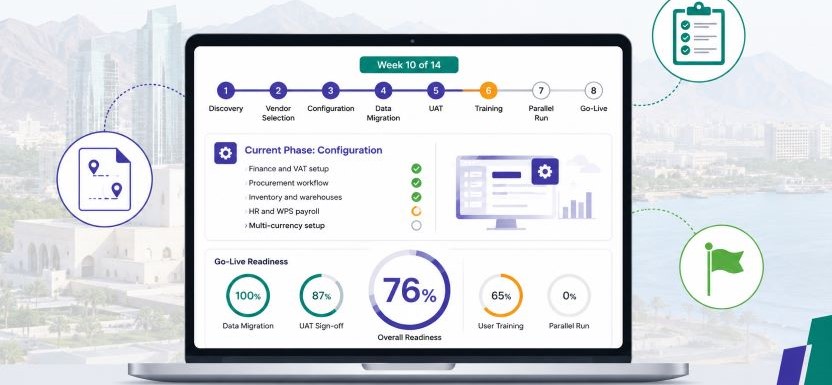
Once a partner is selected, the project plan should define every phase, deliverable, and milestone with clear dates and named owners on both the partner side and your internal team. The plan must include data migration timelines, user acceptance testing dates, training schedules, parallel run periods, and the go-live date with a defined cutover plan. ERP implementation Muscat projects that operate without a written project plan invariably experience scope creep, timeline drift, and budget overrun.
| Project Phase | Duration | Key Deliverable | Internal Owner |
|---|---|---|---|
| Discovery and scoping | 2 weeks | Agreed outcomes and process map | Finance manager |
| Vendor selection | 1 week | Signed implementation contract | Managing director |
| System configuration | 3 to 5 weeks | Configured ERPNext environment | Implementation partner |
| Data migration | 2 weeks | Clean master data in live system | Finance and HR leads |
| User acceptance testing | 1 to 2 weeks | Signed UAT sign-off document | Department heads |
| Training | 1 week | All users trained by role | Implementation partner |
| Parallel run | 2 to 4 weeks | Validated outputs match legacy system | Finance manager |
| Go-live and cutover | 1 week | ERPNext live, legacy system retired | Managing director |
Phase 3: System configuration (Weeks 3 to 7)
Finance and VAT configuration for Muscat businesses
The finance module configuration is the foundation of every ERP implementation Muscat project. ERPNext must be configured with the correct chart of accounts reflecting your business structure, Omani Rial set as the base currency, Oman VAT 5% templates for both output and input tax, your Tax Registration Number entered in company settings, and OTA-formatted VAT return reports activated and tested before any live transactions are posted.
For Muscat businesses that transact in multiple currencies including USD, AED, EUR, or GBP, the multi-currency configuration must be completed at this stage with foreign currency bank accounts created for each currency your business holds, exchange rate update rules configured, and FX gain and loss accounts mapped correctly in the chart of accounts.
Procurement and inventory configuration
The procurement module configuration for a Muscat business typically covers the supplier master with payment terms and approved vendor classifications, multi-level purchase approval workflows aligned to your financial authority schedule, request for quotation templates for your most frequently purchased categories, and three-way matching rules for goods-based purchases. Inventory configuration covers warehouse locations, item master data with reorder levels and lead times, and valuation methods appropriate for your business type.
HR and payroll configuration for Omani compliance
ERP implementation Muscat projects that include the HR and payroll module must configure WPS salary information file generation, Omani Labour Law leave entitlements by contract type and nationality, end-of-service gratuity rules for Omani national and expatriate employee categories, Omanisation ratio dashboards by department, and the payroll approval workflow with designated finance sign-off before WPS file generation. This configuration directly determines whether your business meets Ministry of Manpower obligations from the first live payroll run.
Never configure ERPNext against live production data. Build and test the full configuration in a sandbox environment with sample data before any migration of real business records begins. Changes made to live data after transactions are posted are significantly more complex and costly to correct.
Phase 4: Data migration (Weeks 6 to 8)
The most underestimated phase of ERP implementation Muscat projects
Data migration consistently ranks as the phase most underestimated in time, complexity, and business impact by Muscat businesses undertaking their first ERP implementation. The key principle is to migrate only clean, verified data. Every customer record, supplier record, inventory item, and open transaction that enters ERPNext must be accurate before go-live, because errors in master data propagate through every subsequent transaction and report the system generates.
The standard data migration sequence for a Muscat ERP implementation follows this order: chart of accounts and opening balances, customer and supplier master records, inventory item master with opening stock quantities and valuations, employee records with joining dates, salaries, and leave balances, and finally open transactions including unpaid supplier invoices, outstanding customer invoices, and active purchase orders.
Data cleansing before migration
Before importing any data into ERPNext, deduplicate supplier records, standardise item names and codes, verify customer TRN numbers, and confirm opening stock quantities through a physical count. ERP implementation Muscat projects that skipping data cleansing and migrating raw legacy data as-is can take weeks correcting errors in the live system that should have been resolved before a single record was imported.
Phase 5: User acceptance testing (Weeks 8 to 9)
Testing every workflow against real Muscat business scenarios
User acceptance testing is the phase where your internal team verifies that ERPNext behaves correctly for every workflow your Muscat business runs. UAT must be conducted by the staff who will actually use the system, not by the implementation partner alone. Create a test script that covers every key process: raise a purchase request and verify it routes to the correct approver, post a supplier invoice and confirm VAT is calculated correctly in OMR, run the monthly payroll and verify the WPS SIF file generates in the correct format, check the stock valuation report matches the physical count, and run the VAT return report and verify the output matches the manually calculated figure.
Every failed test is logged, assigned to the implementation partner for resolution, and retested before UAT sign-off. ERP implementation Muscat go-live should not proceed until every critical workflow passes UAT without exception.
Phase 6: Training (Week 9)
Role-based training for every Muscat user group
Training for an ERP implementation Muscat project must be role-specific, not generic. A finance clerk needs to know how to post a supplier invoice, reconcile a bank statement, and run the VAT return report. A procurement officer needs to know how to raise a purchase request, compare supplier quotations, and process a goods receipt. A warehouse manager needs to know how to conduct a stock count, raise a material transfer, and read the inventory valuation report. Delivering a single system-wide training session to all staff simultaneously is one of the most common and most costly implementation mistakes in the Muscat market.
Phase 7: Parallel run and go-live (Weeks 10 to 14)
Running ERPNext alongside your legacy system
The parallel run phase is the final safety net before your Muscat business commits fully to ERPNext. For two to four weeks, every transaction is processed in both systems simultaneously, and the outputs are compared. If the ERPNext payroll run produces a different net pay figure for an employee than the legacy system, the discrepancy is investigated and resolved before the legacy system is retired. If the ERPNext VAT return report shows a different output VAT total than the manual calculation, the configuration is reviewed until the figures reconcile.
Go-live and cutover planning
ERP implementation Muscat go-live should be scheduled at the start of a new month or new quarter to create a clean accounting period boundary. The cutover plan defines the exact sequence of closing the legacy system, importing any final transactions, opening the live ERPNext period, and confirming with the implementation partner that all systems are operational before the Muscat office opens for business on go-live day. For a complete overview of ERPNext capabilities for Omani businesses beyond implementation, visit our ERPSoftware Trends.
Arrange for your ERPNext implementation partner to be available on-site or remotely for the full first week of live operations. The first payroll run, the first supplier payment cycle, and the first end-of-month close in a live system always surface questions that training alone does not fully prepare users for.
Common ERP implementation mistakes in Muscat and how to avoid them
- Assigning implementation to a junior team member without senior management involvement, which leads to misconfigured workflows and poor adoption
- Attempting to go live on all modules simultaneously rather than prioritising finance and procurement first
- Skipping the parallel run phase to save time, then discovering configuration errors only after the legacy system has been retired
- Migrating dirty legacy data without cleansing, creating months of correction work in the live system
- Underestimating the user training requirement, leading to resistance and workarounds that defeat the purpose of the ERP investment
- Not testing the WPS SIF file format before the first live payroll run, risking a Ministry of Manpower compliance breach in the first month
Master ERP implementation Muscat with the right roadmap
ERP implementation Muscat success is not determined by the software you choose. It is determined by how thoroughly you plan, how honestly you clean your data, how rigorously you test, and how seriously you invest in training your team. ERPNext gives Muscat businesses a powerful, open-source, fully localised platform for Oman VAT compliance, WPS payroll, multi-currency finance, and real-time operational visibility. The roadmap in this guide reduces implementation risk, shortens the path to go-live, and maximises the business value your Muscat operation extracts from its ERP investment from the very first month.
Contact Gazelle today for a free ERP implementation assessment tailored to your Muscat business size, industry, and go-live timeline.