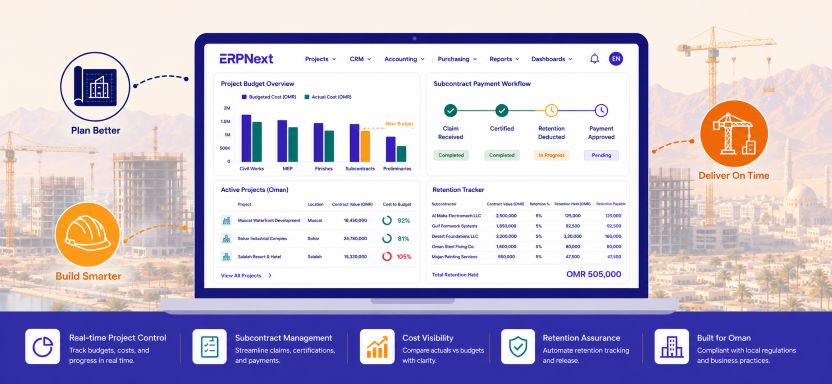
ERP construction in Oman has accelerated sharply as the Sultanate’s infrastructure investment pipeline grows under Vision 2040. From road and highway contractors in the interior to high-rise residential developers in Muscat and industrial facility builders in Sohar Freezone, Omani construction businesses are managing projects of increasing scale and complexity with financial controls that have not kept pace. The consequences are predictable: cost overruns that erode margins, subcontractor payment disputes that delay projects, retention balances that disappear from tracking, and VAT billing errors that trigger OTA penalties. ERPNext addresses every one of these pain points through a single integrated platform designed for how Omani construction businesses actually operate. This guide explains how.
Why do ERP construction in Oman businesses need integrated project financial control?
The Ministry of Housing and Urban Planning continues to oversee substantial public infrastructure programmes across Oman, and the private sector pipeline of commercial, hospitality, and residential projects adds further demand on local contractors and subcontractors. Omani construction companies operating across multiple concurrent projects face a set of financial management challenges that generic accounting software was never designed to solve. Project costs need to be tracked against budgets in real time, not reconciled at the end of the month. Subcontractor payment claims need to be linked to certified progress, not approved on the basis of an invoice alone. Retention money needs to be tracked across dozens of subcontracts simultaneously without falling through the cracks of a spreadsheet. ERP construction in Oman implementation with ERPNext solves all of these challenges from a single platform with no additional modules to purchase and no integration middleware to maintain.
| 28% average cost overrun on Omani construction projects without integrated ERP cost tracking | 45% of subcontractor payment disputes arise from missing documentation and approval gaps | 10wk typical ERPNext go-live timeline for an Omani construction or contracting business | OMR 0 additional licence cost for ERPNext core project costing and procurement modules |
ERP construction in Oman with ERPNext versus operating without ERP
The table below compares the eight most critical construction financial management functions across ERPNext and the manual or disconnected approach most Omani contractors currently use.
| Function | With ERPNext | Without ERP |
| Project budget tracking | Real-time cost vs budget per project | Manual spreadsheet updated weekly or monthly |
| Subcontract management | Digital POs, work orders, and payment claims | Paper-based with email approval chains |
| Material cost allocation | Auto-posted per project code at receipt | Manual allocation at month end |
| Labour cost tracking | Timesheet-linked to project and cost centre | Separate HR system not linked to projects |
| Retention management | Auto-calculated and tracked per subcontract | Manual spreadsheet with high error rate |
| Variation order tracking | Change orders linked to original contract | Separate log with no cost linkage |
| Progress billing to client | Milestone-based invoicing with VAT compliance | Manual invoice creation per milestone |
| Multi-project margin view | Live dashboard across all active projects | Consolidated manually at period end |
Project costing with ERPNext for Omani construction businesses
Real-time project cost tracking from tender to final account
Budget setup and cost code structure
Every construction project in ERPNext begins with a project record that holds the contract value, approved budget broken down by cost category, planned start and finish dates, and client billing milestones. Cost categories can mirror your standard bill of quantities structure: civil works, MEP, finishes, preliminaries, subcontracted packages, and on-site overheads. Every purchase order, supplier invoice, timesheet, and equipment charge posted against the project is allocated to the relevant cost code automatically, giving your quantity surveyors and project managers a live cost view without waiting for the accounts team to run a monthly report.
Cost versus budget dashboard for Omani project managers
ERP construction in Oman management becomes genuinely powerful when project managers can see their cost position in real time without raising a report request. ERPNext provides a dedicated project costing dashboard showing committed costs (approved purchase orders not yet invoiced), actual costs (received and posted supplier invoices), and the variance against budget for each cost code. A civil works manager on a Muscat residential project can log in on site, check that concrete and rebar costs are within budget, and raise a variation order request if an unforeseen scope change pushes costs beyond the approved figure. All of this happens without a single spreadsheet being opened.
Variation order and change management
Variation orders are among the most financially consequential documents in any construction project, and among the most poorly tracked in businesses operating without ERP. ERPNext links every variation order to the original project and contract record, captures the approved value, updates the project budget, and generates a revised billing schedule automatically. Your commercial team always works from the current approved contract value, not a manually updated spreadsheet that may be two versions behind the project reality.
Result: Omani construction businesses using ERPNext for project costing report a significant reduction in end-of-project financial surprises because cost overruns are visible in real time rather than discovered during the final account.
Progress billing and client invoicing
Client billing in Omani construction is milestone-based or progress-claim-based, and each invoice must be VAT-compliant with the correct Oman Tax Authority invoice format. ERPNext generates progress invoices against project milestones with full VAT calculation, TRN display, and Arabic or English output depending on client preference. When a milestone is certified, the billing team raises the invoice directly from the project record in minutes. The invoice flows automatically into the accounts receivable ledger, and the project-level revenue recognition updates without any manual journal entry.
Subcontract management with ERP construction in Oman, ERPNext
End-to-end subcontract lifecycle from award to final retention release
The complete ERPNext subcontract workflow for Omani contractors
The seven-step workflow below shows how ERPNext manages the full subcontract lifecycle for a typical Omani construction project:
| Step | Stage | ERPNext Action | Owner |
| 1 | Subcontract PO raised | Scope, value, retention, and payment terms captured in ERPNext | Project Manager |
| 2 | Multi-level approval | Finance and operations directors approve digitally | Finance Director |
| 3 | Work order issued | Subcontractor receives digital work order with scope | Contracts Team |
| 4 | Progress claim received | Claim entered against PO with certified percentage completion | Site Engineer |
| 5 | Retention auto-calculated | ERPNext deducts configured retention rate from payment | ERPNext System |
| 6 | Payment certificate generated | VAT-compliant OMR payment certificate issued | Finance Team |
| 7 | Retention released at handover | Retention ledger cleared on project practical completion | Finance Director |
Retention tracking and automatic deduction
Retention management is one of the most error-prone manual processes in Omani construction finance. A 5% or 10% retention deduction must be applied to every subcontractor payment claim, tracked as a liability on the balance sheet, and released in two tranches at practical completion and defects liability expiry. ERPNext automates the entire retention lifecycle. The retention rate is configured once per subcontract, deducted from every payment automatically, held in a dedicated retention payable account, and flagged for release when the project stage is certified. Finance teams managing retention across twenty or thirty concurrent subcontracts rely on ERPNext to ensure no retention payment is released early or missed entirely.
Compliance note: Incorrect retention handling is one of the most common causes of subcontractor payment disputes in Oman. ERPNext creates a clear, auditable retention ledger that protects both the main contractor and the subcontractor in any payment disagreement.
Subcontractor performance and document management
ERP construction in Oman implementation with ERPNext stores all subcontractor qualification documents, insurance certificates, performance bond details, and Ministry of Manpower registration records against the supplier profile. Expiry alerts notify the contracts team before a document lapses, preventing the compliance gaps that hold up project execution or trigger operator audit findings on joint venture projects with government clients.
Labour cost and material management for Omani construction ERPNext
Timesheet-based labour allocation to projects
Direct labour costs are one of the most significant and least accurately tracked cost categories in Omani construction businesses that operate without ERP. ERPNext timesheet functionality allows site supervisors and foremen to log daily crew hours against specific project tasks via mobile. Labour costs are calculated at the configured rate per employee grade and posted directly to the project cost ledger, giving the QS team accurate labour cost accruals at any point in the month without waiting for payroll to close.
Material requisition and site consumption tracking
ERPNext material requisition workflows connect the site team directly to the central procurement and stores function. A site foreman raises a material request for a specific project and work package. The system checks the central warehouse’s availability, raises a purchase order if stock is insufficient, and records the material delivery to the site against the project code. When materials are consumed, the issue is posted to the project cost ledger. No unaccounted material costs are sitting in a general stores account at month-end, and no expensive emergency purchases are due to the site team not flagging demand in advance. For a full overview of ERPNext procurement capabilities for Omani businesses, visit our ERPNext implementation and procurement guide for Oman.
Omanisation compliance and HR management for construction businesses in Oman
Omani construction businesses are subject to the Ministry of Manpower Omanisation ratio requirements that vary by company size and project type. ERPNext HR and payroll manages WPS-compliant payroll, end-of-service gratuity under Omani Labour Law, and Omanisation ratio dashboards that update in real time as headcount changes on each project. Ministry of Manpower report formats are configured as standard exports, allowing HR teams to submit compliant documentation without compiling data manually across project sites.
Advantage: ERP construction in Oman implementation with ERPNext consolidates project costing, subcontract management, procurement, HR compliance, and VAT billing into one system, replacing the four to six disconnected tools most Omani contractors currently operate at a high combined cost.
Implementing ERP construction in Oman with ERPNext: a phased roadmap
Most Omani construction businesses can complete a focused ERPNext implementation in 10 to 14 weeks following this sequence:
- Weeks 1 to 2: configure the chart of accounts in OMR with project cost centres, set up Oman VAT templates, and define the project cost code structure.
- Weeks 2 to 4: build the subcontractor and supplier master data, configure approved vendor lists, and set up multi-level purchase approval workflows.
- Weeks 4 to 6: create live project records for all active contracts, import approved budgets by cost code, and set up client billing milestones.
- Weeks 5 to 7: configure retention rules per subcontract type, activate the retention payable ledger, and test the full subcontract payment workflow.
- Weeks 7 to 9: set up HR records, Omani Labour Law leave policies, WPS payroll, and Omanisation ratio dashboards for all project sites.
- Weeks 9 to 12: train QS, commercial, procurement, and finance teams, run parallel operations alongside the legacy system, and go live.
Implementation: Prioritise configuring project costing and subcontract management in the first phase. These two modules deliver the highest immediate ROI for Omani construction businesses by eliminating manual cost reporting and subcontractor payment disputes.
Master construction project control in Oman with ERPNext
ERP construction in Oman implementation with ERPNext gives contractors, developers, and engineering companies across the Sultanate the financial control infrastructure they need to deliver projects on time, within budget, and in full regulatory compliance. Real-time project costing eliminates end-of-project financial surprises. Automated subcontract management and retention tracking remove the manual processes that generate payment disputes and audit findings. VAT-compliant progress billing and Omanisation HR reporting meet every regulatory obligation without consuming your commercial team’s productive time.
The Omani construction businesses that invest in proper ERP infrastructure today will be the ones winning larger contracts, passing client audits, and protecting margins as the sector continues to grow under Vision 2040’s infrastructure agenda.
Contact Gazelle today for a free ERPNext construction assessment tailored to your Omani contracting business, whether you operate in civil construction, MEP, fit-out, or infrastructure development.
Leave a Reply