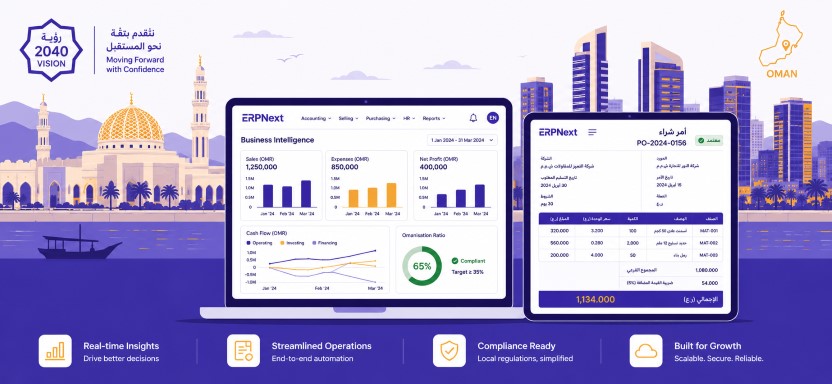
ERPNext Oman Vision 2040 digital transformation is no longer a future ambition for Omani businesses. It is an operating reality shaping procurement decisions, technology investments, and growth strategies across every sector from logistics and manufacturing to retail and healthcare. The Sultanate of Oman has set one of the most ambitious national digital agendas in the Gulf, and ERPNext sits at the practical centre of it for SMEs that cannot afford the enterprise price tags of SAP or Oracle. This blog unpacks how ERPNext directly supports Oman Vision 2040 goals and what that means for your business today.
What Oman Vision 2040 means for business digitalisation
Launched in 2021 and overseen by the Supreme Council for Planning, Oman Vision 2040 sets out a comprehensive roadmap to diversify the national economy away from oil dependence. The digital economy is one of its six core pillars. Vision 2040 explicitly targets a digitally enabled private sector, streamlined government services, and a knowledge-based workforce. For businesses, this translates into a clear government expectation: modernise your operations, adopt digital tools, and integrate with e-government systems.
ERPNext Oman Vision 2040 digital transformation alignment is not a marketing phrase. The platform addresses four specific national digitalisation objectives: paperless operations, data-driven decision making, automated compliance, and interoperability with government portals.
How ERPNext supports Oman Vision 2040 digital transformation goals
Paperless operations and document automation
One of the most visible friction points for Omani SMEs is paper-based documentation across procurement, HR, and finance. ERPNext eliminates paper entirely at every transactional touchpoint. Purchase orders, sales invoices, delivery notes, leave applications, and expense claims are all created, approved, and archived digitally. Approvals happen via mobile notifications. Audit trails are automatic. This directly supports Vision 2040 targets for a paperless government and private sector ecosystem.
Data-driven decision-making aligned with Vision 2040 priorities
Vision 2040 emphasises evidence-based policymaking and business intelligence as growth enablers. ERPNext delivers this through its built-in analytics and reporting engine. Omani business owners and managers get real-time dashboards covering cash flow, inventory turnover, project margins, and sales pipeline without exporting to spreadsheets or waiting for month-end reports. ERPNext Oman Vision 2040 digital transformation is most visible here: businesses that could not afford BI software now have enterprise-grade analytics built into their daily operations.
Automated VAT and regulatory compliance
Vision 2040 includes a clear mandate for digital tax infrastructure. The Oman Tax Authority’s VAT framework is a direct product of this. ERPNext handles VAT invoicing, input credit reconciliation, and return-ready reporting automatically. For Omani SMEs navigating quarterly VAT filings, this removes the single biggest compliance overhead from the finance team’s plate. To explore the full details of how ERPNext handles Omani VAT, read our guide to ERPNext VAT compliance for Oman businesses.
Workforce digitalisation and Omanisation support
Vision 2040 places heavy emphasis on workforce development and Omanisation. ERPNext supports this through its HR and payroll module, which manages end-of-service gratuity calculations, leave entitlements under Omani Labour Law, WPS payroll compliance, and training record tracking. Businesses can monitor their Omanisation ratios in real time and produce reports for Ministry of Labour submissions without manual data collection.
Supply chain visibility for Omani manufacturers and traders
ERPNext Oman Vision 2040 digital transformation extends beyond finance and HR into operations. Inventory management, supplier scorecards, landed cost tracking, and multi-warehouse visibility give Omani manufacturers and trading companies the operational control that Vision 2040 demands of a competitive, export-ready private sector.
Why ERPNext is the right choice for Vision 2040-aligned SMEs in Oman
Several factors make ERPNext uniquely well-positioned for Omani SMEs pursuing Vision 2040 goals:
- Open source foundation: no vendor lock-in, full data sovereignty, and the ability to customise for Omani regulatory requirements as they evolve.
- Arabic language support: full RTL interface and Arabic document output, removing the language barrier for Omani staff and government submissions.
- Cloud deployment: accessible from any device in any emirate or governorate, supporting Oman’s push for mobile and remote work infrastructure.
- Affordable total cost of ownership: Vision 2040 targets SME growth as a key economic driver. ERPNext brings enterprise capability to businesses that cannot justify SAP licensing costs.
- Active Oman partner ecosystem: local implementation partners with in-country knowledge of OTA requirements, Ministry of Manpower regulations, and Vision 2040 compliance expectations.
Getting started with ERPNext for Vision 2040 digital transformation in Oman
A practical ERPNext implementation for Vision 2040 alignment typically covers these priority areas in sequence:
- Finance and VAT: set up chart of accounts in OMR, configure Oman Output and Input VAT 5% templates, and activate the OTA return report.
- HR and Omanisation: load employee records, configure leave policies under Omani Labour Law, set up WPS payroll, and enable Omanisation ratio dashboards.
- Procurement and inventory: create supplier master data, set reorder rules, and activate the landed cost tool for import-heavy trading businesses.
- Sales and CRM: activate the customer portal for digital order placement and connect the sales pipeline to inventory for real-time availability checks.
- Reporting and BI: configure executive dashboards for cash flow, gross margin, and Omanisation ratio so leadership can make Vision 2040-aligned decisions daily.
Key insight: Businesses that implement ERPNext in phases rather than all at once achieve faster adoption, lower disruption, and measurable ROI within the first quarter.
ERPNext Oman Vision 2040 digital transformation in practice
Consider a mid-sized Omani trading company in Muscat with 45 employees, managing imports from Asia and distribution across three governorates. Before ERPNext, their VAT filings were manual, their inventory was tracked in spreadsheets, and HR compliance was handled reactively. After implementing ERPNext with a local Gazelle partner, they automated quarterly VAT returns, reduced inventory discrepancies by 60%, and produced their first Omanisation compliance report in minutes rather than days.
That is ERPNext Oman Vision 2040 digital transformation in practice: not a high-level national strategy, but a measurable improvement in how an Omani business operates every single day.
Conclusion: align your business with Oman Vision 2040 through ERPNext
ERPNext Oman Vision 2040 digital transformation gives Omani SMEs a practical, affordable, and fully localised platform to meet national digitalisation goals without enterprise-scale budgets. From paperless finance and automated VAT compliance to workforce digitalisation and real-time business intelligence, ERPNext maps directly onto what Vision 2040 demands of a competitive Omani private sector.
Take the next step: Contact Gazelle today for a free ERPNext consultation and learn how your business can align with Oman Vision 2040 goals this year.
Leave a Reply